

 EN
EN
Summary
Barebow archery is not simply “a recurve without a sight”: it is a discipline with its own identity, very specific rule requirements and a technical style that rewards repeatability over gadgets. Under the current World Archery rules, barebow inherits the basis of recurve, but prohibits sights and stabilizers, requires the complete setup to pass through a 12.2 cm ring, does not allow a draw check, does allow string walking and face walking, and authorizes a rest, plunger, tab with anchor plate and regulated uniform marks.
In Spain, the current reference is the existing Spanish federation, the Royal Spanish Archery Federation; in practice, when people refer to “FETA” today it is advisable to read RFETA, which is the official acronym used in current federation regulations. The key idea is simple: in disciplines recognized by World Archery, RFETA applies WA rules and adds the national framework for what WA does not fully cover, such as U15 categories, some specific national championships and charts of ages, target faces and distances.
In practical terms, three things explain almost all performance in barebow: a legal and well-balanced bow, correctly spined arrows and a stable shooting sequence. If the equipment is properly tuned, the archer can devote their energy to what matters: posture, anchor, crawl control, expansion and a clean release.
Barebow and Current Regulations
The comparison in this article is based on the World Archery books in force since January 27, 2026 for target, field and 3D, and on RFETA Regulation 2201 for championships and events, with a revision published on August 18, 2025, as well as the RFETA chart of categories, distances, target faces and pegs.
| Aspect | World Archery | RFETA/FETA | What it means in practice |
|---|---|---|---|
| Regulatory hierarchy | WA Books 2, 3 and 4 | In WA disciplines, RFETA applies WA and adds national exceptions | In pure equipment terms, Spanish barebow is basically WA barebow |
| Sight and stabilizers | Prohibited in barebow | Same | If you use a sight or stabilizer, it is not barebow |
| Aiming references | No useful marks on the bow window; no lip/nose marks on the string | Same | Be very careful with tapes, marks and “fixes” |
| Rest and plunger | Allowed; the pressure point may not be more than 2 cm behind the pivot point | Same | Typical legal setup: magnetic rest + plunger |
| Attachments and weights | Weights/dampers are permitted if the bow passes through the 12.2 cm ring and do not help with aiming or measuring | Same | Modern barebow may carry mass, but within the ring |
| Tab and fingers | Tab with anchor plate allowed; uniform marks and up to two different lengths; no extra “memoranda” | Same | The tab is a central tuning tool in string walking |
| Arrows | Maximum shaft diameter 9.3 mm and point diameter 9.4 mm; all identical and marked | Same | Arrow control is common to WA and RFETA |
| Target | Barebow 50 m Round, Match Round, team and mixed team; 18 m Round and 18 m matches | RFETA summarizes indoor and outdoor by age group; in senior category, barebow competes at 18 m indoors and 50 m outdoors | Spain defines distances and target faces by category |
| Field and 3D | In 3D, barebow shoots from the blue peg between 5 and 30 m; field and 3D have their own rounds and eliminations | RFETA also assigns blue to barebow in senior category and gives recommendations for U21/U18/U15/+50 | The reference for national courses is very consistent with WA |
| Categories | U18, U21, Women/Men, 50+ in target/field/3D; world target titles remain reserved for recurve and compound | RFETA chart: pre-benjamín to veteran; infantil and younger compete as U15; there are specific national barebow championships | RFETA adds a much more detailed developmental layer |
| Classification and awards | Barebow has Target Awards at 18 m and 50 m, and Arrowhead badges in field | RFETA homologates WA or RFETA events for high scores, awards and national records | Classification is not just about placing: result homologation also matters |
Table sources: current World Archery regulations for target, field and 3D; RFETA Regulation 2201; RFETA summary of categories, target faces, distances and pegs.
There are two regulatory nuances worth engraving in your mind. First: World Archery recognizes barebow rounds, records and awards in target archery, but World Archery Championships target titles remain reserved for recurve and compound; however, there are barebow world titles in field and 3D. Second: RFETA provides specific national coverage for Traditional, Longbow and Barebow championships indoors and outdoors, while also organizing the ecosystem of ages and promoted categories.
Another very useful detail for competing without unpleasant surprises: in target archery, wind indicators attached to the equipment are permitted for recurve and compound, not for barebow. It is one of those small rules that can become an administrative zero if nobody remembers it in time.
Equipment to Start Well and Improve
The ideal barebow setup is sober, rigid, repeatable and easy to adjust. The legal bow starts from the basis of the recurve, but in a “clean” version: no sight, no stabilizers and no useful aiming marks. Today, the usual approach is to work with an ILF metal riser, detachable limbs, magnetic rest, plunger and a specific tab for string walking. The string may be multicolored, with one or two nocking points, but without nose or lip marks or aiming aids.
Riser and limbs
For an adult club archer, 25" remains the most versatile size; what matters is not “the most expensive riser,” but one that allows good limb alignment, logical mass distribution and passing the ring control when you add weights. With limbs, the temptation to increase poundage too soon is one of the most costly barebow mistakes: a smooth, stable limb teaches more technique than a hard and nervous limb.
String
In barebow it matters much more than it may seem. Not only because of speed, but also because of brace height stability, nock fit and clean arrow departure. A well-served string with solid nocking points prevents more problems than it usually receives in the budget.
Arrows
Under the rules they may be of any type provided they do not damage the target face excessively, but they must be identical in appearance, marked with name or initials and respect the limit of 9.3 mm shaft diameter and 9.4 mm point diameter. In target barebow, the choice of spine and point-insert combination is decisive for matching the bow properly at both 18 m and 50 m.
Rest, plunger, tab and quiver
The rest and plunger are permitted, with the restriction that they must not provide aiming assistance. The tab, however, is almost the “analog computer” of barebow: it may have an anchor plate, uniform stitching and regulated marks, but no additional notes. The quiver may be worn on the belt, hip, back or placed on the ground.
| Level | Recommended setup | What to focus on | Indicative range |
|---|---|---|---|
| Beginner | Simple ILF riser, soft limbs, magnetic rest, basic plunger, clean tab, 8-12 reasonable carbon or carbon/aluminum arrows | Learning form, anchor and consistency; not chasing speed | €450-850 |
| Intermediate | Stiffer and heavier riser, mid-range carbon limbs, specific barebow tab, better arrow tolerances, second string set | Consolidating crawl chart at 18 m and 50 m, and competing indoors/outdoors | €900-1,600 |
| Advanced | Premium riser or highly weight-tuned riser, high-performance limbs, fine competition arrows, duplicate spares, premium tab | Maintaining performance in wind, maximum repeatability and zero improvisation | €1,800-3,500+ |
The ranges are indicative as of May 2026. They are based on market references that place, approximately, entry-level risers at €144-197, basic limbs at €93-95, dozens of beginner shafts around €110; a mid-range setup with risers around €415-600, limbs around €299-475 and mid-range arrows at about €22.50 per shaft; and a high-end setup with risers from €670-963, limbs from €830-1,150 and premium dozens in the range of €401-470, plus rest and plunger normally around €25-30 each.
Bow and Arrow Tuning
Tuning in barebow should follow an almost sacred rule: change only one variable at a time and write it down. Technical tuning documents insist precisely on this: start with a well-spined arrow according to the manufacturer’s selector, record exact measurements and then correct with bare shaft tests, fine tuning and microtuning.
Brace height, tiller and nocking point
For recurve, a classic starting reference places brace height at approximately 8" to 9 1/4" for 66", 8 1/4" to 9 1/2" for 68" and 8 1/2" to 9 3/4" for 70". The sensible recommendation is to start in the lower part of the range and increase in small increments until you find the bow’s smoothest and quietest point. In addition, brace height alters dynamic spine: raising it tends to make the arrow behave weaker; lowering it, stiffer.
Tiller should be measured and documented from day one. In barebow it becomes more relevant than in sighted recurve because string walking changes the relative load on the upper and lower limbs; that is why it is not a “decorative” adjustment, but part of the system’s balance. There is no need to obsess over a magic number: what matters is that the bow launches cleanly and repeats.
For the nocking point, the classic approach with finger shooting starts from a position slightly above square; it is then refined with vertical impact tests and bare shaft. If the bare shaft impacts clearly higher or lower than the fletched arrows, the first suspect is the nocking point.
Spine, bare shaft and FOC
Spine is not guessed: it is first selected with a chart or selector, and then confirmed on the range. The bare shaft planing test remains a very valid tool. For a right-handed archer, a bare shaft that impacts far to the left of the fletched arrows usually indicates behavior that is too stiff; to the right, too weak. If the difference exceeds about 15 cm at 18 m, you are usually no longer in “fine tune”: you are dealing with a system incompatibility that calls for reviewing spine, point, plunger or poundage.
As for FOC, or front of center, it describes what percentage of the arrow’s total weight is concentrated in its front half. A practical formula is: FOC = ((balance point – half of the arrow) / total length) × 100. As a general technical reference, Easton considers it reasonable to work within a front balance range of approximately 7% to 16% FOC, and reminds us that point and insert weight is one of the most powerful controls for modifying both the balance and the dynamic behavior of the arrow.
What to check when something is not going well
If the bow “does not speak clearly,” it usually does so in one of five ways. Tail high or tail low in flight: first check the nocking point. Bare shaft very far apart laterally: check actual spine, plunger tension, point weight and poundage. Strange grouping at short distance and better grouping at long distance: suspect clearance. Noisy or nervous bow: go back to brace height. Inconsistent crawl between distances: the problem is not always the bow; very often it is the tab, the finger reference or the anchor routine.
Shooting Technique That Works
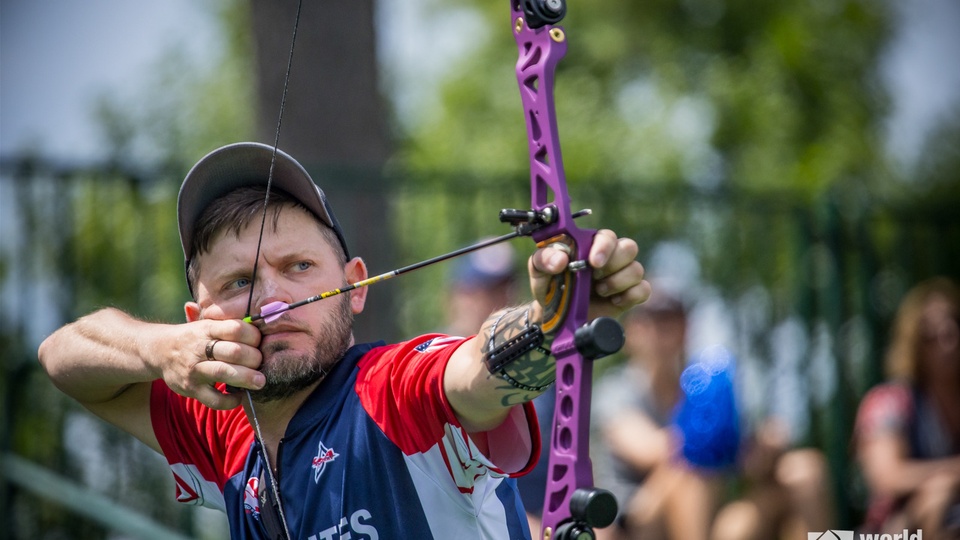
Barebow biomechanics share the foundation of precision recurve: a stance close to 90° to the target, upright head, back-driven draw, consistent anchor, sustained pressure in the drawing elbow and a clean follow-through. World Archery’s technical guide insists on exactly that: good technique does not begin with aiming, but with posture and an efficient back-driven draw.
The big difference in barebow is not “how you push and pull,” but how you reference the distance. The rules allow string walking and face walking; in modern target archery, many people prefer string walking with a very fixed anchor and different crawls depending on the distance, because it provides a lot of repeatability. Gap shooting and point-on remain valid, especially for those looking for a simpler system or working with courses and mixed distances.
The sequence that ages best is usually this: stable foot placement, relaxed grip on the handle, unhurried raising of the bow, continuous draw to anchor, short but real expansion, relaxed release and the string hand finishing back, not outwards. World Archery describes that final phase as a hand traveling toward the back of the head while the bow hand continues “pushing” toward the target; the torso remains still and gives the arrow a solid base for a clean departure.
In barebow, there are also three very common bad habits: collapsing from looking too much at the point, pulling with the biceps instead of the back and plucking the string on release. All three destroy the most beautiful crawl chart in the world. If the technique does not repeat, the distance table will not repeat either.
Training Plan and Common Mistakes
The following periodization is an indicative proposal for a club archer who can complete three to four weekly sessions. The logic is simple: first build the technical base, then tune the equipment, then expose the system to volume and, finally, compete with intention.
-
Weeks 1-3:
- Postural base and anchor.
- Grip and release control.
- Arrow choice and initial crawl.
-
Weeks 4-6:
- Brace height, nocking point and bare shaft.
- Consolidation at 18 m.
- General strength and scapula work.
-
Weeks 7-9:
- Transition to 30 m and 50 m.
- Building the crawl chart.
- Pressure ends and set simulation.
-
Weeks 10-12:
- Microtuning and distance confirmation.
- Full competition simulation.
- Volume reduction and final activation.
If I had to summarize barebow training in a single idea, it would be this: do not train only shots; train repeatable decisions. A good weekly block combines low-fatigue technique, grouping sessions, a dose of basic strength for the rotator cuff-scapulae-core and, when competition approaches, timed rounds, scoring and waiting routine. Technique improves, yes, but confidence in the equipment also improves.
The most common mistakes are predictable. The first is increasing poundage before consolidating technique. The second, wanting to fine-tune when the anchor is still changing. The third, doing string walking “by eye” without recording crawls or differences in light, wind or fatigue. The fourth, chasing the center with the hand, that is, breaking the release because of aiming anxiety. They are all corrected in the same way: return to the process, reduce the noise and recover an objective reference.
Competing with Your Head
In target archery, modern barebow lives between two worlds. In qualification rounds, you win with a stable average; in eliminations, with emotional management. In target match play, barebow uses the set system: two points to the winner of the set, one to each archer in a tie, and the individual match closes when reaching 6 set points; teams close at 5. In field, the round consists of 24 targets and 3 arrows per target; in 3D, 24 targets and 2 arrows per target, with barebow on the blue peg from 5 to 30 m. Tiebreaks in field look at 6s and 5s; in 3D, 11s and 10s.
At RFETA level, the national layer organizes the terrain very well: in senior category, barebow is summarized as 18 m indoors and 50 m outdoors with a 122 cm target face, and in field/3D the barebow division aligns with the blue peg in senior category, with specific recommendations for U21, U18, U15 and veterans. That is one of the major useful differences between WA and RFETA: WA defines the international architecture; RFETA tells you exactly how it lands on the Spanish circuit.
- 48 h before: check equipment without improvising last-minute changes.
- Legal bow? Confirm that the setup complies with barebow regulations.
- Check the 12.2 cm ring and absence of sight.
- Measure brace height, tiller and nocking point.
- Check strings, servings and nocking points.
- Inspect arrows, nocks and fletching.
- Prepare tab, quiver, spares and tools.
- Confirm crawl chart and distances.
- License, schedule, clothing and footwear.
- Warm-up and activation.
- First smooth arrows.
- Enter the competition routine.
In safety and maintenance, it is best to be boring. And that is a good thing. Frequently check the condition of the string, serving, rest, plunger, screws and alignment; inspect shaft straightness, fletching and nocks; and do not settle for “it looks fine,” because many tuning problems are born from damaged components. In addition, WA target archery fields require wide safety zones behind the target if there is no suitable backstop, and RFETA adds, for indoor and outdoor events, the use of sports footwear with rubber soles, while in field and 3D it also allows hiking boots.
If you accompanied this article with visual material, I would prioritize five pieces: a side photo of the anchor and release; a diagram of the 12.2 cm ring control; a simple diagram of bare shaft versus fletched arrow; a visual crawl table for 18 m and 50 m; and an infographic of RFETA pegs in field and 3D. Well chosen, these images greatly reduce the learning curve because they turn abstract concepts into visible decisions.
Sources and Documentation Consulted
- World Archery Rule Book 2, version January 27, 2026
- World Archery Rule Book 3, version January 27, 2026
- World Archery Rule Book 4, version January 27, 2026
- Royal Spanish Archery Federation
- RFETA Regulation 2201 for championships and events
- RFETA chart of target faces, pegs and distances
- RFETA category table
- Easton Tuning Guide
- World Archery Guide to Recurve Technique
- Easton: FOC
- Easton: basic FOC balance guide